Skip to content Skip to footer

History of Our Parish

The history of any parish is, in many respects, a reflection of the
history of the whole Church. It was the 24th session of the Council of
Trent (1545-63) that ordered that boundaries of parishes should be
defined. The bishop may erect a new parish by way of creation,
union or division. Our parish was erected by division when it was cut
from the mother parish of St. Andrew’s by the then Archbishop
Thomas Roberts. It was placed under the protection of St. Theresa
of the Child Jesus and like its lovely little patroness, has a history of
thorns as well as roses.

It is not, however, boundaries or groups of dwellings that constitute
a parish; it is essentially a certain body of the faithful and their
parish priest. The occasion was an auspicious one when this group
of the faithful came together to attend Holy Mass which was
celebrated in the parish for the first time on Sunday, June 9, 1946.
Rev. Fr. Theophilus Gomes the then Principal of St. Andrew’s School
was asked to set up the parish on an organized basis. Fr. Gomes
offered the Sunday Mass for the people of Pali at St. Anthony’s
School, Pali, and then went off to Gomes’ shed and offered Mass
there. During the week he offered Masses for 3 days at Khar and for
3 days at Pali. This continued for a year. He overcame many
difficulties and managed to lay the foundation of the parish,
especially by acquiring property of 7850 square yards for which he
made a payment of Rs. 107,170.

In November 1948, Archbishop of Bombay, Most Rev. Cardinal
Gracias, sent for Fr. George Proksch, SVD who was in Bombay for his
final year studies in Hindi and Sanskrit. He told Fr. Proksch: St.
Theresa’s parish is orphaned by the death of Fr. Gomes and the new
establishment is in need of a priest. Since SVD’s were on the lookout
for ‘fresh fields and new pastures, a transit station like Bombay was
most welcome. Fr. Proksch conveyed to his then Superior,
Fr. Valentine Zimmermann and it was agreed.

December 3, 1948 marks the beginning of SVD’s mission activity in
St. Theresa’s parish. It was on the feast of St. Francis Xavier, Apostle
of the East, Fr. Proksch accompanied by Fr. Henry Remedios, vicar of
St. Andrew’s church, visited the villages of Khar and Pali. Fr. Peter Braun
stepped into the shoes of Fr. Proksch in February, 1951 and immediately
set about the task of consolidating the spade work of Fr. Proksch.

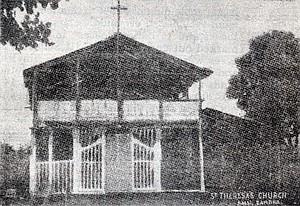
Old-woodhouse-church


In 1949 the rustic little wooden chapel was ready and served as the first church for Pali-Khar. For 5 years this humble “Bethlehem” often humorously referred to as “The air-conditioned Woodhouse”!– was the centre of all parish activities.

December 19, 1948 is a significant date to remember, for it was on that day that the people decided to set up a compact parish. It was the “de facto” birth of the parish. This singular achievement by Fr. Proksch will be remembered in the annals of the history of the Parish. He established the sodalities of the Assumption of the Blessed Virgin Mary in 1950 consisting of 149 men, 128 women and 86 young women. The sodality patrons’ feasts were days of great activity and the “woodhouse chapel” a scene of cheerful good fellowship. The men’s group had St. Francis Xavier (December 3) as their patron, the women, St. Catherine of Siena (April 30) and the young women, St. Bernadette (September 22).

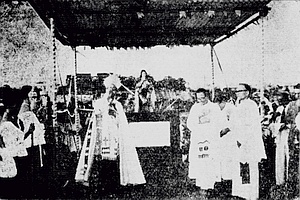
Fr. Peter Braun stepped into the shoes of Fr. Proksch in February, 1951. He set before himself the idea and ideal of building first a school. On October 3, 1952, Cardinal Gracias, Archbishop of Bombay, blessed and laid the foundation stone of the new school. In addition to the 6 plots bought by Fr. Gomes, Fr. Braun acquired 6 more plots for the church and the school between November 29, 1951 and November 15, 1957, the total area being 4985 sq. yards for Rs 56,710. October 1955 saw the parish in a gala affair when her newly- consecrated son, the Most Rev. Dr. Longinus Pereira, the Auxiliary Bishop of Bombay, blessed the school and celebrated Pontifical High Mass on the terrace. From then Mass was discontinued in the “Woodhouse Chapel” and a wing on the 1st floor of the school building was assigned as a temporary chapel – a house more worthy of the Lord.

The remarkable work done by Fr. John Partsch from 1951 to 1956 in
assisting Fr. Braun in the establishment of the school is still
remembered by many old-timers. The Braun Pratsch team functioned
effectively and the completion of the first stage of the school building
is almost entirely due to their efforts. The silent deeds of some of the
people of Pali and the surrounding areas who parted with their land
and even a little of their pay packets in the cause of the church are
remembered as the “unsung” heroes of St. Theresa’s parish.

Most of the work of supervision of the school building had been
entrusted to the hard working parish assistants, R.J. Partsch, SVD
and Fr. John Huebner, SVD. Fr. John Partsch (1951-1956) and the
subsequent assistants helped to bring about great changes in ten
years. Fr. Francis Hoenen (1951-1951) was the first assistant who
after going to the Belgium Congo was made Bishop. The seed that
had been carefully planted by Fr. Gomes, closely nursed by Fr. Proksch,
quickly sprouted under the care of Fr. Braun and methodically tended
by Fr. Huebner fully bloomed under the supervisory eye of Fr. Leo
Krezeminski (1959 – 1966).

Fr. John Huebner took charge of the parish in 1957 and Fr. Kevin O’Toole
SVD became his assistant. Fr. Huebner held consultations with architects
and selected the site of the church where it now stands.

Fr. Leo Krzeminski who arrived from Ratlam was appointed the new
Parish Priest in 1959. He took little time to evaluate matters and with
characteristic grit got the plan of the church off the drawing board.
The seed that had been carefully planted by Fr. Gomes, closely nursed
by Fr. Proksch quickly sprouted under the care of Fr. Braun and
methodically tended by Fr. Huebner fully bloomed under the supervisory
eye of Fr. Leo. On October 3, 1959 Bishop Longinus Pereira laid the
foundation stone of the Church on the feast day of the Patroness.
Fr. Leo took another important step to record the activities of the parish
by starting the Parish Bulletin. The first number containing a photo of
St. Theresa on the front page was out in March, 1960.

Fr. Leo secured the honorary services of a noted Australian architect,
Mr. James Hogan, who planned the Church building but unfortunately
had to cut short his stay in India and return to Australia before the building
could be completed. The work was then entrusted to Mr. Chapsey Mistry.
He managed to get sizable funds for the Church building and the project
was finally completed.

The big day dawned on October 2, 1962, when Cardinal Gracias on the eve of the feast day of the Patroness St. Theresa, blessed and consecrated the new Church amidst much rejoicing.

Fr. Kevin O’Toole (1966 – 1971) who had a five year tenure in the parish was for some time professor of English in the SVD seminary in Indore. Fr. Augustine Chellanthara who was the youngest parish priest
in Bombay, took charge of the parish in May, 1972.

UNIQUE CHURCH ARCHITECTURE
No historical survey would be complete without reference to the “monumental and revolutionary departure” from the Gothic and baroque church architecture in India which, makes St’ Theresa’s
Church unique in its individuality and incorporates the most modern concept in building design. Emphasis had been placed to make the
people feel the presence of God by focusing attention on the main tenets of the Catholic Church.
Laying-the-foundation-stone Mr. James Hogan, who conceived the idea and drew the plan, kept in mind clarity and integrity. Thepreference for glass walls by using metal louvres and the use of pre-stressed concrete girders make for architectural flexibility. The arrangement of Mangalore bricks in varying geometrical design with its inter-locking textural composition breaks the monotony of a plain concrete wall. As one enters the Church, the 30-feet high slender black cross, “reaching the infinite” as it were, catches the eye. It epitomizes the aspirations of the anguished hearts. Imageless the Cross overwhelms one as a sign of redemption. In striking simplicity is the altar, a slab
of marble. The symmetrical and rectangular squares that honeycomb the Church facade vary in size in an interesting modulation. The light sweeping through the small glass louvres wedged between the squares of precast cement concrete exhibit a scintillating array of exotic colours. Sunlight flows in cascades and the bright colours of red, purple, blue and green of the polychromatic glasses from West Germany on the left, well light up the Altar, bringing greater awareness of the reality of the Divine Being. By contrast, the stations of the Cross in the rear are done in subdued cut glass. St. Theresa’s Church is a landmark in church architecture in India.